On June 30, AWS announced a billion-dollar investment in a new Forward Deployed Engineering organization.[1] The plan embeds engineers in customer companies in pods of five or six for roughly 45-day engagements, building agentic systems using the customer’s own data and leaving the customer self-sufficient when the pod withdraws.[2] AWS called the pods “frontier teams” and noted that many of the engineers had built their own AI services.
The same day, AWS published a service availability page announcing the retirement of roughly 20 services and features.[3] Amazon Kendra, Amazon Q Business, and Amazon Bedrock Agents will enter maintenance and be closed to new customers from 30 July.[4][5][6] Ten SageMaker AI features went with them.
One announcement spends a billion dollars putting AWS engineers inside customer businesses. The other withdraws the products that those customers were meant to use. Three weeks later, Amazon confirmed it was closing its San Francisco AGI Lab and cutting roles across its artificial general intelligence organization.[7][8]
Read separately, these are a product cull, a spending initiative, and a research retreat. Read together, on the calendar they occupy, they are one decision about which layer of the artificial intelligence business Amazon intends to own.
Three vectors and one direction
Amazon is spending at the bottom of the stack and at the top, and withdrawing from everything in between.
Downward, into the fabric. Andy Jassy told investors in February that Amazon expected roughly $200bn of capital expenditure in 2026, predominantly in AWS, pointing to what the results release called “seminal opportunities” in AI, chips, robotics, and satellites.[9] Project Rainier went live with nearly half a million Trainium2 chips across multiple United States sites and a stated path beyond a million.[10] Trainium3 sits behind it.[11] This is the only layer Amazon is attempting to own outright, and the only one where it is building rather than buying the alternative.
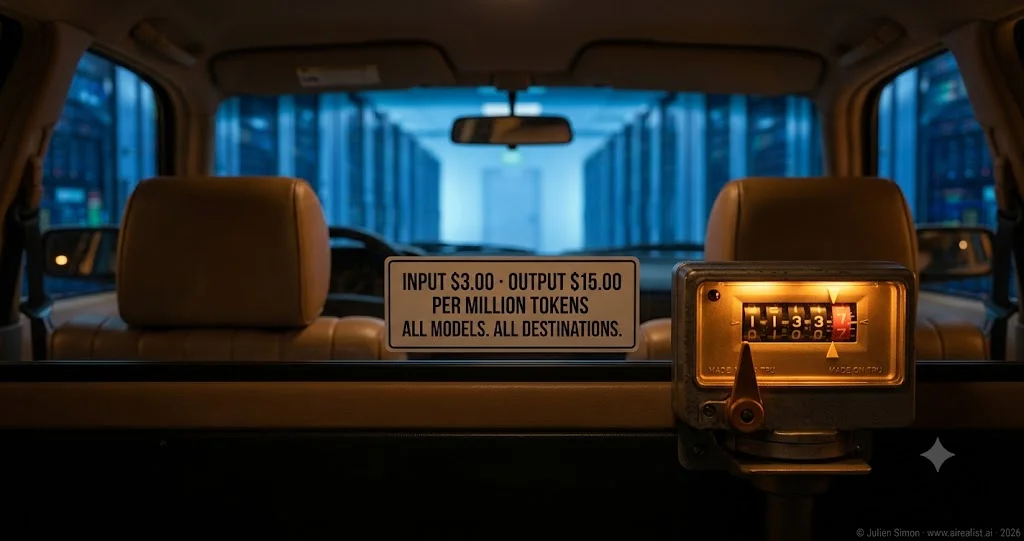
Outward, for the intelligence. Anthropic supplies the frontier under a commitment of more than $100bn over 10 years and up to 5 gigawatts of capacity, powered by Amazon’s own silicon.[12] The equity position produced $16.8bn in pre-tax gains in the first quarter of 2026, while the AWS segment grew 28% in the same quarter and carries more than $15bn in annualized AI services revenue.[13] That gain is a non-cash mark on a private company’s valuation, booked through non-operating income, and it reverses if Anthropic’s next round prices flat or down. Bank of America estimates that Anthropic-related workloads alone could contribute more than $1.5bn in sequential AWS revenue growth in the second quarter.[14] That is an analyst estimate, not a disclosure, and if it is near right, it describes customer concentration as much as momentum. One fact is observable: Claude’s per-token rates on Bedrock match Anthropic’s own API to the cent.[15] AWS doesn’t mark Claude up. Its margin is whatever sits between retail and the undisclosed remittance, plus everything a production workload consumes besides the model, and that second meter is the one no model provider can take away.
The arithmetic explains the rest of the strategy. A frontier laboratory is a capital sink competing for the same engineers, accelerators, and megawatts as a business already growing at 28%, with a winner-take-most payoff. Instead, equity plus a supply contract does three jobs at once: it secures the output, it locks the supplier’s training and serving onto Amazon’s silicon for a decade, and it books the upside as investment gains, not research cost. The capacity remains full, and the income statement shows a research organization rather than a frontier-scale training program, a difference measured in tens of billions.
Forward, to the customer. The $1 billion announced on 30 June goes to engineers who sit inside the customer’s building. Francessca Vasquez, the AWS vice president who runs the organization, framed the pitch around speed, and the named early customers include the Allen Institute, Cox Automotive, the NBA, the NFL, Ricoh, and Southwest Airlines.[1][2] Amazon is late to this: Palantir has run forward-deployed engineering for over a decade, and Salesforce, Google Cloud, and Anthropic all offer similar versions.[16]
Look at what that vector costs. Embedded engineering carries service margins, and a company that spent twenty years teaching investors to value self-service software economics is putting a billion dollars into headcount that does not scale like software. Firms accept that when the customer won’t reach production without it, and the consumption on the other side outweighs the margin surrendered. The forty-five-day cycle and the insistence on leaving customers self-sufficient are the tell: these pods are a customer acquisition cost, not a consulting line.
AWS frames the initiative as customer obsession, and on its own terms, it is. It is also, on Amazon’s terms, consumption: the pods deploy onto Bedrock and the surrounding services, and the annuity AWS is buying is the meter running after the engineers leave. And this survives the test that killed the software. An embedded engineer holds the one input that tooling shipping with the model can’t replicate: the customer’s own context. That’s why AWS is paying people margins for a function whose software equivalent it just retired.
What sits between the fabric and the customer is the part Amazon is vacating: its own frontier models, its own retrieval, agent, and assistant products, and the tooling a customer would use to build models themselves. Amazon has concluded that owning intelligence is a worse business than metering it, and it’s paying to occupy both ends of the pipe instead.
The interesting question isn't whether Amazon failed here; parts of this were failures, and public ones. It's what Amazon did with the verdict.
The organization chart is the strategy document
In December 2025, Amazon replaced Rohit Prasad at the head of the AGI organization with Peter DeSantis, a longtime cloud infrastructure executive.[17] CNBC describes the resulting unit plainly: it builds AI models and includes groups working on silicon development and quantum computing.[7]
That’s not a research organization with infrastructure attached; it’s an infrastructure organization with research attached, and the reporting line tells you how the company values each. A model program that reports to the executive who owns chips, data centers, and quantum is a program understood as a load on capacity rather than as a product line.
The AGI Lab itself was founded in December 2024, built around several dozen employees Amazon acquired from Adept, including its co-founder David Luan, and grew to roughly eighty people at its peak. More than a dozen of the Adept hires have since left, Luan among them in February.[8] The Information, which reported the closure first, describes what the lab was for: building software to make AI agents more useful.[18] Amazon confirmed the site closure and said frontier model research continues under Pieter Abbeel, the Berkeley professor who joined in 2024 when Amazon licensed the technology and hired the team from his robotics startup, Covariant.
Secondary reporting indicates the cuts fell on model customization and post-training roles, a claim carried by trade press and not confirmed by Amazon.[14] If it holds, it points somewhere specific: post-training is the work that turns a base model into a competitive product, and a company that keeps a research lab while cutting that function has made a choice about which of the two it is doing. Amazon has not disclosed which teams were affected, so hold it loosely.
The company’s own account is consistent with this, if read literally. A spokesperson said Amazon was sharpening its focus on the initiatives that matter most for customers so it could move faster on what counts.[7] Customers sit at the top of the stack. Frontier research is not where AWS meets them, and a billion dollars of embedded engineers is.
What a landlord keeps
The defeat reading has been made in print: The Next Web called the lab closure the clearest sign yet that Amazon had stepped back from a frontier race it never really led.[19] On that reading, the models never landed, the products never took, and a company retiring Kendra and Q Business is making a virtue of a loss. Half of that is simply true, and the tooling shows it best.
Take SageMaker Clarify, a bias-detection tool built for tabular models. AWS rebuilt it for the new architecture, enabling foundation model evaluation to move from preview in November 2023 to general availability in April 2024.[20][21] Twenty-six months later, it went to maintenance.[22] Ground Truth followed the same arc, and Ground Truth Plus, converted earliest of all in May 2023, is the only item on the June 30 page to reach the full end of support.[23][24][3] Earliest conversion, hardest death. Whether AWS built the wrong thing or built the right thing too late is a fair debate. The outcome is not.
For now, the surviving services are close to the hardware. SageMaker HyperPod, the one part of the platform still shipping features monthly, does cluster resilience: gang scheduling, continuous provisioning, job recovery, and capacity reservation on Trainium.[25][26][27][28][29] The scheduling logic exists in open source, and a Kubernetes engineer will say so. What does not exist outside the operator is the input: which node sits on which network spine, which accelerator is degrading, which instance is about to be retired, and whether the capacity exists to be reserved at all. The position is the privileged telemetry, not the feature.
Call it the fabric test. A function that runs against a model goes to whoever ships alongside the model. A function that requires privileged access to physical capacity stays with whoever owns the capacity. It predicts the consequential AI retirements on the June 30 page: Kendra was a managed retrieval system, Bedrock Agents was an orchestration system, and Q Business was an application over a corpus, and none of the three needed hardware.
The landlord position has a second advantage. It’s indifferent to which tenant wins: capacity bills identically whether the customer runs Claude, Nova, Qwen, or something that does not exist yet, while every layer AWS dropped required backing a horse.
This also explains why Nova continues to exist, which is otherwise the loose thread in the argument. A landlord that buys its headline product from a single supplier needs a cap on what that supplier can charge. A competent house brand at the commodity tier does that job without winning anything: it sets a price floor, absorbs workloads where frontier capability is wasted, and keeps a credible team on the payroll.
Nova doesn’t have to beat Claude. It has to make Claude’s price negotiable.
And it explains why AWS now hosts its competitors' tooling rather than fighting it. Managed MLflow occupies the ground Clarify and Experiments were built to hold, and the product page that once sold Experiments now sells MLflow.[30][31][32] Experiments itself was never formally retired. The APIs still answer, and no deprecation notice exists anywhere; AWS confined it to the legacy Studio experience and pointed the documentation at its replacement.[33] A product superseded in place leaves no notice to audit. A week after freezing Model Monitor, the AWS machine learning blog published monitoring guidance built on open-source Evidently, with the results organized in MLflow.[34] Hosting the winner captures the workload without financing the losing race.
The only one of the four
Set Amazon against its peers, and the position stops looking like an industry trend and starts looking like a choice. This is what the four say in public, not what they plan in private.
Google builds the whole stack: its own accelerators, models, and surfaces, and it carries the research cost because the models feed products it owns end to end. Microsoft resells third-party models on Azure, as AWS does, but it also sells an assistant, and the quality of an assistant is a claim about the model inside it. Meta is the cautionary case: it spent enormously on infrastructure and could not buy the research culture to make it pay, which is the failure version of stepping back and the version the market reaches for by default.
Amazon is none of these, and the distinction is less the direction than the decisiveness. Microsoft may yet drift the same way; its Azure catalog is already multi-model. Only Amazon has done it explicitly and completely, on one page, in one quarter. It rebuilt its intelligence tooling for the new architecture, shipped it, then withdrew, while raising capital expenditure toward $200bn, contracting a frontier supplier onto its own silicon for a decade, and committing a billion dollars to engineers who deploy that supplier’s models inside customer businesses.
These are the actions of a company that priced the layer and declined it. The distinction carries a forecast. A company that lost a layer re-enters it when conditions improve, and its retreat is temporary. A company that priced a layer and declined it doesn’t come back, and here the barrier to return is one Amazon built itself: re-entering the frontier would now mean competing against its own anchor tenant, on its own silicon, against a product its own billion-dollar deployment force installs. The supply contract works as more than a substitute for the laboratory. It locks the door behind it. Everything since December 2025 points the same way: a reporting line that subordinates models to infrastructure, a contract measured in gigawatts and decades, and a billion dollars aimed at deployment rather than research.
Redundancy, not retreat
Which makes the AGI Lab closure something other than a failure signal.
A laboratory does two things. It secures a capability you cannot otherwise obtain, and it holds an option on architectures nobody has commercialized yet. Amazon has bought the first through a 10-year supply contract using chips it designed. It has not closed the second, at least for now: Abbeel remains, research continues, and the AGI organization is still hiring.
What Amazon canceled sits between the two, and that is why the reported cuts to model customization and post-training matter more than the closure of a site. Post-training is how a base model becomes a frontier product. Research is how you hold the option and judge what your supplier is selling. And the reportedly cut roles are the same functions Nova Forge now sells to customers as a service: continued pre-training, fine-tuning, and preference optimization on their own data.[34] The cuts and the product are one move. Amazon kept the option, stopped performing the frontier work for itself, and externalized it to paying customers.
The exposures fit on one list. First, Amazon has contracted for output, not acquired a capability: Anthropic sets its own roadmap, prices its own models, serves Amazon’s competitors elsewhere, and runs a deliberately multi-cloud posture. The dependence runs both ways: since Amazon holds the equity, the training capacity, and the largest distribution channel, the mutual dependence remains stable until one side’s alternatives improve faster than the other’s. Second, the arrangement is subject to competition law. The UK Competition and Markets Authority examined the partnership in 2024 and closed its inquiry on jurisdiction, not merits, while the Federal Trade Commission ran a parallel market study.[35][36] The facts have since outgrown that clearance: a $4bn investment one way now sits beside a $100bn procurement the other, binding the two companies more tightly than anything the 2024 inquiry reviewed. Whether an authority would reach the same conclusion today is unknowable.
Amazon has evidently judged the whole list cheaper than financing a laboratory it was unlikely to win with. That judgment is defensible on today’s numbers.
What would break this
The strongest counterargument is that Amazon is still building models, and it is. Nova 2 shipped at re:Invent in December 2025 in Lite, Pro, Sonic, and Omni variants, alongside Nova Forge for organizations building custom frontier models.[37] An AWS executive would argue, with some justification, that a portfolio cull inside a funded model program is ordinary discipline rather than a change of direction.
Except that the executive who runs the program has already conceded the premise. DeSantis told CNBC in June that it is “a fair narrative” that Amazon’s models “haven’t been at the very frontier” for the largest workloads, while hoping Amazon would be in the leading-model conversation in the coming year.[38] In the same interview, he put Nova 2 at roughly 50,000 customers since December, said Amazon should be considered on par with Nvidia in its ability to design and produce chips, and confirmed there's no timeline for Jassy’s April suggestion that Amazon might sell Trainium racks to third parties. Fifty thousand customers is breadth at the commodity tier, which is what a price floor accumulates. Comparing yourself to Nvidia is what a silicon company does. And floating rack sales are a landlord wondering whether to sell the fittings too. The counterargument’s own spokesman is describing the thesis.
The thesis breaks if:
Nova receives a genuine frontier push, and a Nova model competes at the top of the Bedrock catalog on customer usage rather than vendor benchmarks.
Nova Forge lands anchor customers at scale.
The AGI organization is rebuilt outside the infrastructure reporting line, because that reporting line is the clearest signal in the whole sequence.
AWS reclaims one of the displaced tooling categories with a proprietary product that wins against the open-source incumbent.
Anthropic’s non-AWS capacity share grows materially, because that would suggest the option value in this arrangement always sat with the supplier, and that Amazon was priced into the landlord role rather than choosing it.
The second-quarter results on 30 July are the near-term test: watch capital expenditure, AWS margin, and whether Nova appears in the earnings narrative at all.
What this means for the people buying it
For a buyer, this is one question. Before adopting any vendor AI feature, ask whether the function could be built by someone who does not own a data center. If it could, price in migration, and keep the integration thin. If it cannot, treat the dependency as infrastructure and negotiate exit assumptions over years. And do not audit vendor risk off deprecation notices alone: Experiments show a product can be retired by a documentation edit without appearing on any list.
Five years ago, I argued that software would eat machine learning: teams would assemble models instead of building them, write as little code as possible, and let tooling do the rest.[39] The June 30 page is that prediction arriving.
Everything in the middle of the stack that could be expressed as software has been eaten, mostly by tooling that ships with the model.
What survives is what software cannot eat: the chips, the buildings, the power, and the people who install the result. Amazon saw that outcome and reorganized around it. Retire what software already ate. Spend a billion dollars deploying what it cannot.
The durable position was never the model. Nor was it the middle of the stack, where services competed on open source on launch day and existed mostly to thicken a product manager’s promotion document.
Back to cloud 101: the durable position is always the meter.
Notes
[1]AWS invests $1 billion to embed AI forward deployed engineers with customers, About Amazon, 30 June 2026. Describes the agentic-first model, the compression of deployment timelines, the customer self-sufficiency goal, and the named early customers.
[2]AWS puts $1 billion into new AI unit to embed engineers with customers, CNBC, 30 June 2026. Source for pod size, engagement length and the Vasquez interview.
[3]AWS Service Availability Updates, AWS What’s New, 30 June 2026. The ten SageMaker AI features are A2I, Clarify, Debugger, GeoSpatial, Ground Truth, Mechanical Turk, Model Monitor, Profiler, Role Manager and Studio Lab. Ground Truth Plus is listed separately under end of support. The same page also retires directory, mainframe and console-management services unrelated to AI; the body’s “consequential” excludes those and legacy items such as Mechanical Turk and Studio Lab, which reached maintenance through obsolescence rather than displacement.
[4]Amazon Kendra availability change, AWS documentation.
[5]Amazon Q Business availability change, AWS documentation.
[6]Amazon Bedrock Agents Classic maintenance mode, AWS documentation. Bedrock models, Knowledge Bases and Guardrails are unaffected; migration is directed to AgentCore.
[7]Amazon lays off some employees in its AGI unit, CNBC, 22 July 2026. Source for the composition of the AGI organisation, the DeSantis appointment, and the company statement.
[8]Amazon confirms it’s closing key AI site in San Francisco but says work on its top models continues, GeekWire, 24 July 2026. Company spokesperson confirmation of the site closure, the lab’s founding and headcount, the Adept departures, and Abbeel’s role.
[9]Amazon.com Announces Fourth Quarter Results, Amazon Investor Relations, 5 February 2026. The release carries Jassy’s guidance of about $200bn in 2026 capital expenditure and the “seminal opportunities” framing; his statement that the spend would be predominantly invested in AWS was made to analysts on the accompanying call, perCNBC’s same-day report.
[10]AWS’s Project Rainier: the world’s most powerful computer, About Amazon, 29 October 2025.
[11]Amazon EC2 Trn3 UltraServers, AWS product page. Vendor-published performance claims; not independently verified.
[12]Anthropic and Amazon expand collaboration for up to 5 gigawatts of new compute, Anthropic, 20 April 2026; Amazon’s counterpart release isAmazon announces $5B Anthropic investment, up to $20B more, About Amazon, 20 April 2026. Source for the $100bn ten-year commitment, the up-to-5GW capacity, and the Trainium2-through-Trainium4 scope.
[13]Amazon.com Announces First Quarter Results, Amazon Investor Relations, 29 April 2026. Source for the $16.8bn of pre-tax gains booked in non-operating income from the Anthropic investments and for AWS segment sales up 28% to $37.6bn. The annualised AI services revenue figure is from management commentary on the accompanying earnings call.
[14]Amazon Cuts AGI Jobs While Pouring $200 Billion Into AI Infrastructure, TechTimes, 23 July 2026. Secondary source for the Bank of America estimate and for the reported composition of the cuts; both should be treated as reported rather than confirmed, and the Bank of America figure is an analyst estimate.
[15] Representative Amazon Bedrock on-demand rates,aws.amazon.com/bedrock/pricing, retrieved July 2026; parity with Anthropic’s direct API perAnthropic platform pricing documentation. Claude Sonnet at $3/$15 per million input/output tokens on both, with matching promotional windows. Rates as of July 2026 and subject to change.
[16]Amazon’s AWS commits $1 billion toward new unit for embedded AI engineers, The Manila Times, 2 July 2026, on prior forward-deployed engineering organisations at Palantir, Salesforce, Google Cloud and Anthropic.
[17] Reported December 2025; see note 7 for the CNBC account of the appointment and the scope of the resulting organisation.
[18]Amazon Shuts AI Agent Research Lab In AGI Layoffs, The Information, July 2026. Paywalled; the description of the lab’s remit is quoted via GeekWire at note 8.
[19]Amazon shuts its AGI Lab in fresh AI layoffs, The Next Web, July 2026.
[20]Amazon SageMaker Clarify now supports foundation model (FM) evaluations in preview, AWS What’s New, 29 November 2023.
[21]Amazon SageMaker Clarify now supports foundation model evaluations, AWS What’s New, 25 April 2024. General availability excluded GovCloud, China and several commercial regions listed in the announcement.
[22]Amazon SageMaker Clarify availability change, AWS documentation.
[23]Power Your LLM Training and Evaluation with the New SageMaker AI Generative AI Tools, AWS Artificial Intelligence blog.
[24]Amazon SageMaker Ground Truth Plus now supports human feedback and fine-tuning data for Generative AI, AWS What’s New, 30 May 2023.
[25]SageMaker HyperPod now supports gang scheduling for distributed training workloads, AWS What’s New, 8 April 2026.
[26]Amazon SageMaker HyperPod now supports continuous provisioning for Slurm-orchestrated clusters, AWS What’s New, 25 March 2026.
[27]Accelerate large-scale AI training with Amazon SageMaker HyperPod training operator, AWS Artificial Intelligence blog. The HyperPod elastic agent is described as an extension of PyTorch’s ElasticAgent, and fault detection draws on node health checks and AWS retirement notices.
[28]Amazon SageMaker HyperPod release notes, AWS documentation, recording Trn2 and Trn2n support for Slurm and Amazon EKS clusters.
[29]Reserve Flexible Training Plans for ML workloads, AWS documentation.
[30]Amazon SageMaker now offers a fully managed MLflow capability, AWS What’s New, 19 June 2024.
[31]Fully managed MLflow 3.0 now available on Amazon SageMaker AI, AWS What’s New, July 2025.
[32]Accelerate generative AI development with Amazon SageMaker AI and MLflow, AWS product page, retrieved July 2026.
[33]Amazon SageMaker Experiments in Studio Classic, AWS documentation.
[34] The overlap between the reportedly cut post-training and customisation roles and the capabilities Nova Forge sells (continued pre-training, supervised fine-tuning, direct preference optimisation on customer data) is drawn from the TechTimes report at note 14 and from Amazon’s Nova Forge description at note 37; the role composition of the cuts remains unconfirmed by Amazon.
[35]Amazon / Anthropic partnership merger inquiry, Competition and Markets Authority case page. Merger inquiry launched 8 August 2024; phase 1 decision 27 September 2024 that the partnership does not qualify for investigation under the merger provisions of the Enterprise Act 2002.
[36]FTC Launches Inquiry into Generative AI Investments and Partnerships, Federal Trade Commission, 25 January 2024. Section 6(b) orders issued to the companies involved in the Microsoft-OpenAI, Amazon-Anthropic and Google-Anthropic investments.
[37]AWS re:Invent 2025: Amazon announces Nova 2, Trainium3, frontier agents, About Amazon, December 2025. Covers the Nova 2 family (Lite, Pro, Sonic, Omni), Nova Forge’s open-training checkpoint model, and Nova Act’s move to general availability; announcements made 2 December 2025.
[38]Amazon has lagged OpenAI and Anthropic, but AI chief sees path to catch up in ‘coming year’, CNBC, 17 June 2026. Direct interview with Peter DeSantis; source for the frontier concession, the Nova 2 customer figure, the Nvidia comparison, and the status of potential Trainium rack sales first suggested by Andy Jassy in April.
[39]The Age of Machine Learning As Code Has Arrived, Hugging Face blog, 20 October 2021, which I co-authored while Chief Evangelist at Hugging Face.